by Stephen Kuster
We start from below. In the fluorescent corridors of a subterranean backstage, we follow a woman named Zhao Tao. Amid the usual backstage commotion, Tao weaves through stagehands, security guards, and other performers in search of a simple Band-Aid. All the performers are wearing costumes that resemble something one would expect in Las Vegas but with a more culturally appropriative motif. Tao, for instance, dons a bejeweled sari, replete with a nose ring. The handheld camera moves us through the ensuing chaos, and just as the noise reaches a fever pitch, a manager arrives on scene to usher everyone upstairs. We, however, pause on Tao before cutting to the surface and entering the pageantry which ensues onstage. In front of a filled auditorium, the women parade downstage with their arms extended to showcase their clothing. Once lively and expressive, the women assume mostly blank faces, though punctuated with a suggestion of a smile or a glimmer in their eyes. The now still digital camera overexposes the image and blows out the background, leaving us only to focus on them, their faces almost unreal. As they begin to dance, we marvel at the sheen of this spectacle, but its surface lacks depth.
This is the opening to Jia Zhangke’s 2004 film The World. The film follows Zhao Tao and her boyfriend Chen Taisheng, who work as a performer and a security guard at a theme park in Beijing. Named World Park, the site also serves as the source for the film’s title. Instead of a traditional narrative, where cause and effect drive the film to some closure or resolution, The World drifts through the lives of Tao and Taisheng, as they interact and intersect with their colleagues, and as they attempt to escape the confines of their social condition. Such meandering translates into a decidedly slower pace, and in the face of late capitalism’s always on, always rabid demands, slowness takes on political significance, particularly within China’s hyper-acceleration. Like Jia’s other work and other sixth generation filmmakers, The World investigates post-socialist China’s attempts at industrialization not through its drivers, but its passengers. Put differently, The World is concerned with the people upon whom China’s fast-growing capitalism is built, those people who are hidden from view.
For such an investigation of those who are the collateral of capitalism’s progress, the film’s setting proves critical. On the outskirts of Beijing, World Park is said to bring the world to its visitors without ever needing to leave the city. Its grounds house numerous international landmarks, albeit miniaturized. These testaments to the world include the Taj Mahal, the Eiffel Tower, St. Peter’s Basilica, and Big Ben, and the list goes on. Despite being mere replicas of these sites, guests seem no less enamored. Behind the film’s characters, we often see families and couples taking photos before these imitations. For example, in front of the Leaning Tower of Pisa, we watch as visitors pose: their hands are to the side as if they are holding up the leaning structure. Not only does the park replicate the world, but guests also simulate the world’s tourists.
Many critics have aligned The World with Jean Baudrillard’s concept of the simulacrum, in which the representation of the real has replaced the real, becoming the hyperreal. It is an easy reading, and it is a reading, which the film does not deny. The World often stages and exposes the absurdity of its location. Security guards lug water coolers on their backs in front of the Great Pyramids of Giza. World Park’s New York skyline still includes the Twin Towers, as though 9/11 never happened, and to make matters worse, it’s a fact that Taisheng boasts about, “The Twin Towers were blown up on September 11. We still have them.” In moments such as these, it is sensible to read Jia’s work along Baudrillard’s axis.
Yet Baudrillard’s postmodern condition only has so much mileage. More often than not, critics fail to realize this when writing about The World. When Baudrillard writes about the unreal experience of the world, he does so from a specific position. Reading the newspaper in Paris, Baudrillard is disconnected from the world about which he writes, where catastrophes in the Global South barely register as information, where what should be the events of the world barely make the news. But this is not the lived experience for the characters of The World. Tao and Taisheng cannot escape reality, despite where they work. The laborers at World Park are marked by immobility more than anything else, and Jia Zhangke is invested more in this cruel contradiction: despite having the world at their fingertips, those who work at World Park remain as immobile as ever.
Mobility is a central concern for The World. Passports are a constant topic of conversation. In the film, passports are not a document that is taken for granted, but figure more as a rarefied object, signaling potential and hope. Yet they are an unrealized symbol for almost none of the workers at the park possess one. They can only dream of them. Transportation itself is paid particular attention as well. Throughout the film, we spend time with characters drifting from one place to another. Modes of transportation also regularly enter Tao and Taisheng’s dialogue. After a fight with Tao, Taisheng interrogates how she got home, and Tao tersely retorts, “I had plenty of choices: bus, subway, taxi.” In an air of defense, Tao tries to lay claim to freedom through her choice of transportation, working within a late capitalist logic that equates one with the other. While Tao may have choice in local transportation, she does not have freedom in her movements. Instead, her life proves the shortcomings of contemporary capitalist choice. When an ex-boyfriend from her home providence unexpectedly appears at World Park, she expresses disbelief that he is in Beijing. To her surprise, he responds, “Simple, I just bought a ticket.” But this simplicity is out of grasp for Tao and her co-workers. As planes fly above them, they gaze up to the sky and wonder what kind of person flies in them. The closest they will ever get is the grounded plane in the park. Instead of true mobility, movement for the characters in The World resembles the two-car monorail that runs around the park. The automated speaker talks about reaching far off destinations, but in fact, its passengers encircle the same park time and time again, moving but going nowhere.
The one thing that interrupts the meandering of Tao and Taisheng’s lives is digital technology. Released in 2004, The World is deeply mired within the change from the analog to the digital, and the film explicitly mediates this change. Interspersed throughout The World are animated interludes, which depart from the otherwise slow cinema aesthetic of extended long takes and minimal camera movement. What motivates these animations are text messages from other characters. The messages transport the characters into other spaces, almost like cyberspace itself. Consequently, the animations finally afford them the opportunity to move beyond their immediate surroundings. In one instance, Tao soars above the skies of Beijing. Her arms are outstretched, as she becomes a human plane. In another, Taisheng receives a text from a potential affair, “Drop by when you can.” Soon Taisheng is racing on a white horse, riding gallantly to his lover, as flower petals fly past him. In these interludes, technology provides a momentary escape from capitalist exploitation, or more accurately, technology becomes the means of articulation for the characters’ fantasies of flight. If Tao will never fly in real life, relegated to working as a pretend flight attendant for a plane which will never leave the ground, she is able to soar above her entrapment in this all too brief line of flight. As other critics have noted, technology seems to be one of the lone hopes for the characters in The World.
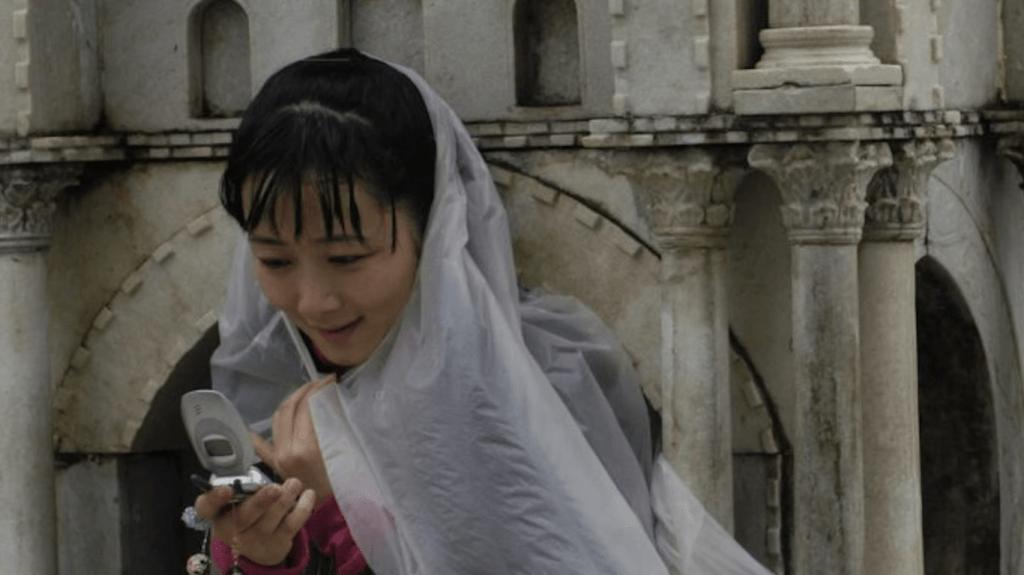
But the promises of digital technology in The World are more ambivalent than what may appear on the surface. While early animated sequences exhibit unprecedented mobility for the characters, this mobility becomes increasingly strained by the film’s conclusion. A late text message informs Taisheng about the death of a friend, who died from a construction accident at night. Such deathly accidents are not anomalies, rupturing the normal operations of capitalist temporality; rather, they constitute the very demands of a globalizing China trying to emerge as an economic powerhouse. Or in the last animated sequence, Tao finds herself in the sinking abyss of dark waters, instead of the skies above Beijing. In light of these later interludes, even the earlier promises feel less certain. The film’s first text message reads, “How far can you go?” How much does digital technology afford its users is a pressing question in The World. And whereas certain Californian ideologies in Silicon Valley may have us believe that access to and participation through digital technologies will bring freedom and mobility to all the world’s inhabitants, the answer that The World supplies is decidedly less optimistic. As the experiences of Tao and Taisheng show, some material realities cannot be transcended by the promises of the digital.
As the film drifts towards its end, there seems to be no escape for Tao and Taisheng. Where once there was choice, Tao and Taisheng’s options now appear exhausted. A line casually delivered by Tao earlier in the film now stands as a premonition, “Being stuck here all day will turn me into a ghost.” And ultimately, ghosts are what Tao and Taisheng become. In a final accident, the two die from a gas leak. In the slow morning light of a winter’s day, their stiff bodies are laid side by side in the snow. Everyone around them is in commotion, but the camera lingers on them, arrested in their death. But this is no ending. The film cuts to black, and we hear their voices once more. “Are we dead?” asks Taisheng. “No, this is just the beginning,” answers Tao. It is a puzzling end to The World, one that seems to beg further questioning. What might happen when we attend to the ghosts created by the force of global capitalism? Might their postmortem haunting signal that global progress is nothing but an empty promise, built off the labor and death of those who are hidden from our view? To stay with Tao and Taisheng, to begin with their deaths, may spell a potential to rethink the logics and redress the injuries, upon which we have built our present world.
 Achssprünge
Hinterlasse einen Kommentar